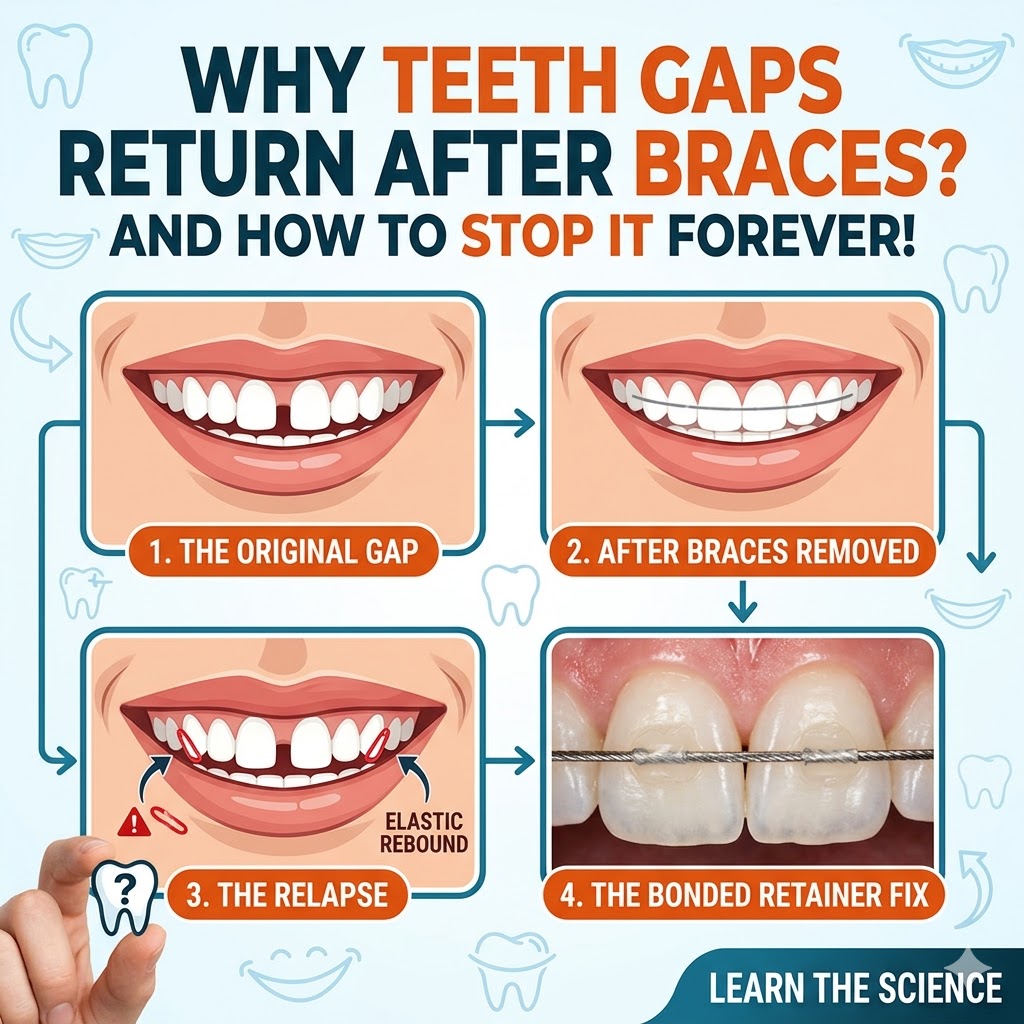
You have just spent four long years wearing braces. You’ve endured the tightening appointments, the restricted diet, and the countless adjustments. Finally, the day arrives, the brackets come off, and your smile is absolutely flawless. But within just two hours, the familiar gap between your front teeth begins to aggressively reappear.
This nightmare scenario isn’t just a hyperbolic fear; it was recently captured in a viral video where a visibly frustrated young woman experienced exactly this. A gap she spent years closing had opened right back up before she even made it through the day.
If you are panicking about your own smile or preparing to get your braces removed, you are likely wondering how this is even physically possible. Why do teeth shift so quickly, and more importantly, how can you prevent all that expensive dental work from going to waste? Let’s dive into the anatomy of your smile, the reasons behind orthodontic relapse, and the permanent solution dentists recommend.
The Frustrating Reality of Orthodontic Relapse
The technical term for a gap between your front teeth is a diastema. While many people embrace their diastemas as unique and beautiful features of their smile, others choose to close them through orthodontic treatments like traditional braces or clear aligners.
However, diastemas are notoriously stubborn. Closing the gap is only half the battle; keeping it closed is where the real challenge begins. In the dental community, the period after your braces are removed is known as the “retention phase,” and it is arguably the most critical part of your treatment. Without proper retention, the human body will naturally try to revert to its original state, a process known as orthodontic relapse. According to dental professionals, gaps that have been closed orthodontically will attempt to reopen an astonishing 50% of the time.
But why are our teeth so eager to move back to their starting positions? The answer lies hidden beneath your gums.
The Two Hidden Causes Behind Returning Teeth Gaps
When you look at a tooth, you are only seeing the crown. Beneath the surface, there is a complex system of tissues, fibers, and bone that dictates how and where your teeth sit. When a gap reopens almost immediately after braces are removed, it is typically due to two primary biological factors.
1. The Gum Tissue Rebound
The first culprit is the gum tissue itself, specifically the bit of gum that lives between your teeth (the interdental papilla).
When you have a significant gap, there is a certain amount of gum tissue occupying that space. As your braces slowly pull the teeth together to close the gap, that gum tissue doesn’t just disappear. Instead, it gets squeezed and compressed between the newly positioned teeth.
Think of this compressed gum tissue like a tiny sponge that has been squished. It doesn’t want to stay compressed. The moment the braces are removed and the mechanical pressure holding the teeth together is gone, that tissue naturally wants to decompress and rebound. As it expands back to its original shape, it exerts pressure on the sides of the teeth, gently but firmly pushing them apart again.
2. The “Bungee Cord” Ligaments
The second, and perhaps most powerful, reason your teeth shift is due to your periodontal ligaments.
Your teeth are not rigidly fused directly to your jawbone. Instead, they are suspended in their sockets by a network of tiny, elastic fibers called periodontal ligaments. You can think of these ligaments as microscopic bungee cords that hold your teeth in place while acting as shock absorbers when you chew.
When braces move your teeth to a new position, these “bungee cords” are stretched out of their original resting state. Much like a stretched rubber band, these ligaments have a memory. Even after years of treatment, they remember where they used to be, and they desperately want to return to their original, relaxed state. When the braces come off, the tension from these ligaments immediately pulls the teeth, attempting to drag them right back to where they started.
The Ultimate Solution: The Bonded Retainer
If you are dealing with a stubborn gap, relying solely on a removable plastic retainer at night might not be enough to combat the persistent pull of your gums and ligaments—especially in the first few crucial hours after your braces are removed.
To combat this, orthodontists frequently turn to a highly effective solution: the bonded retainer (also known as a fixed or permanent retainer).
A bonded retainer is a very thin, custom-fitted piece of metal wire that is permanently cemented to the lingual (back) side of your teeth. Typically placed across the front four to six teeth, this wire acts as an invisible anchor. Because it is bonded directly to the teeth, it provides constant, 24/7 resistance against the “bungee cord” ligaments and the compressed gum tissue. It physically locks the teeth in their new, perfect positions, making it impossible for the gap to reopen.
Is a Bonded Retainer Right for You?
While bonded retainers are the gold standard for preventing diastemas from returning, there are a few things to keep in mind if you are considering one:
-
Oral Hygiene: Because the wire is permanently fixed to the back of your teeth, you cannot floss normally. You will need to use specialized tools, like floss threaders or water flossers, to clean between the teeth and prevent plaque buildup.
-
Maintenance: While they are called “permanent,” bonded retainers can occasionally break or become unglued if you bite down on something exceptionally hard. Regular dental checkups are required to ensure the wire remains intact.
-
Suitability: While excellent for the front teeth, bonded retainers are not typically used for the back molars. Your dentist will likely still recommend a removable clear retainer to wear at night to protect the alignment of your entire arch.
The Takeaway
Watching a gap reopen hours after completing years of orthodontic treatment is a heartbreaking experience, but it is a biological reality driven by the natural resilience of your gums and ligaments. If you are starting your orthodontic journey to close a gap, or if you are nearing the end of your treatment, be proactive. Speak to your orthodontist about the retention phase and ask if a bonded retainer is the right safeguard to protect your investment and keep your new smile perfectly intact.