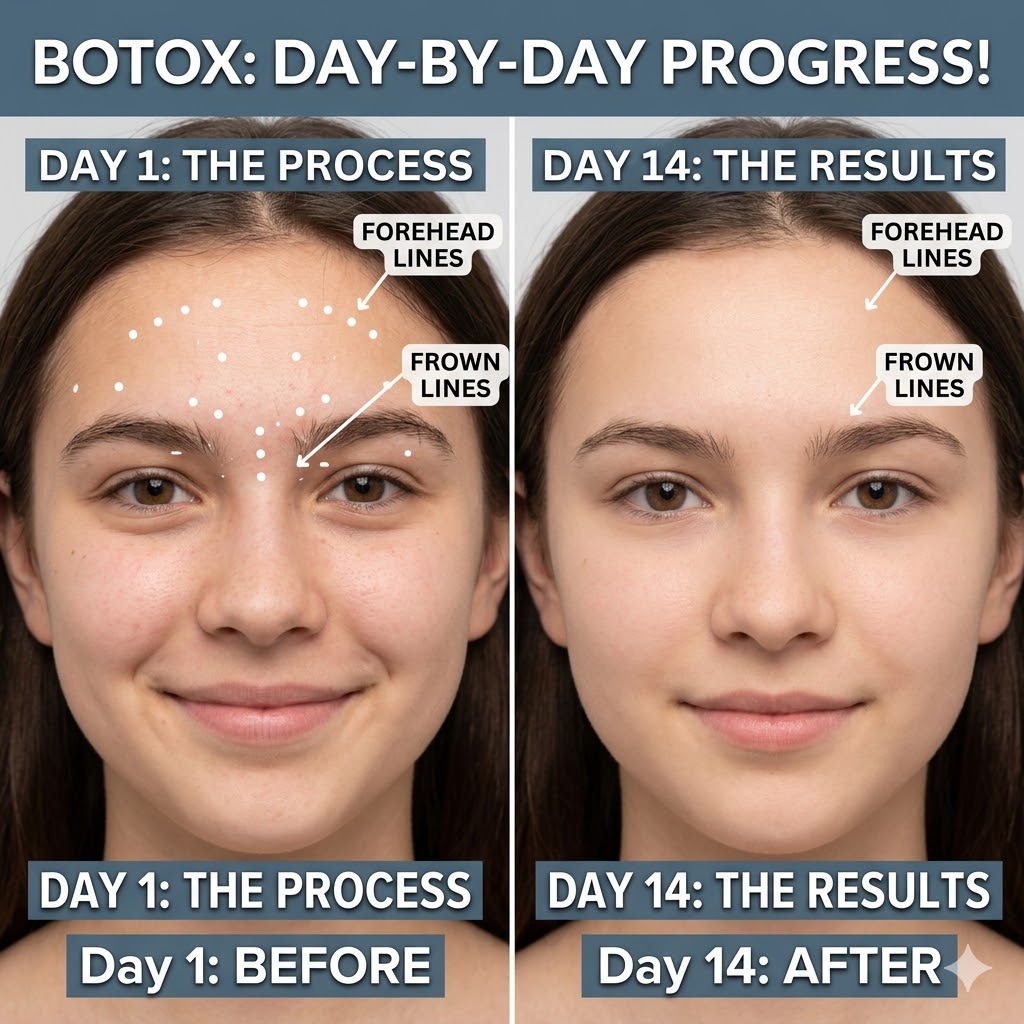
In the ever-evolving world of aesthetic medicine and skincare, few treatments have achieved the widespread popularity and trusted reputation of Botox. Recently, a fascinating trend has taken over social media platforms: the “Botox set-in” time-lapse. These videos, much like the viral clip analyzed by medical professionals online, offer a transparent, day-by-day look at how neurotoxins take effect. But what exactly is happening beneath the skin as those dynamic wrinkles slowly fade away?
Whether you are a seasoned aesthetic patient or someone considering their first treatment, understanding the science, the targeted muscles, and the realistic timeline of Botox is crucial. Let’s dive deep into the real human experience of neuromodulators and explore what it truly takes for Botox to set in.
Decoding the Injection Sites: Where Does Botox Go?
When watching a Botox time-lapse, you will often notice small white dots or marked areas on the patient’s face immediately after the procedure. These represent the precise injection sites chosen by the practitioner. In the upper face, which is the most common area for preventative and restorative anti-aging treatments, practitioners generally focus on two primary anatomical zones:
1. The Frontalis Muscle (Forehead Lines) The frontalis is the broad muscle that stretches across your forehead. Its primary function is to lift your eyebrows. Over time, the repeated action of raising the brows creates horizontal creases across the forehead. By carefully injecting Botox into the frontalis muscle, practitioners can temporarily relax this movement. The goal isn’t to freeze the face completely, but rather to soften the muscle’s pull, allowing the overlying skin to smooth out while maintaining natural human expression.
2. The Glabellar Complex (Frown Lines) Located between the eyebrows, the glabellar complex is responsible for the deep “11 lines” or frown lines that appear when we concentrate, squint, or feel frustrated. These muscles pull the eyebrows downward and inward. Treating the glabellar complex with Botox relaxes these depressor muscles, which not only smooths out the vertical lines but often results in a subtle, refreshed lifting of the brow area.
The Science of Waiting: Why Isn’t Botox Instant?
One of the most common misconceptions about Botox is that you will walk out of the clinic with an instantly smooth face. As the daily progression videos clearly demonstrate, this is not the case.
Botox works by blocking the chemical signals from the nerves that tell the muscles to contract. This process happens at a microscopic cellular level and requires time to interrupt the neural pathways.
The Standard Timeline:
-
Days 1 to 3: During the first 72 hours, you will likely see absolutely no change. The injection sites may have minor redness or swelling, but your muscle movement will remain completely normal.
-
Days 4 to 7: This is when the “heavy” feeling typically begins. You might try to raise your eyebrows or frown and notice a slight resistance. The lines will begin to soften, and the muscles will feel sluggish.
-
Days 10 to 14: By the two-week mark, the neurotoxin has fully bound to the receptors. This is generally considered the peak of the treatment, where the targeted muscles are fully relaxed, and the skin appears at its smoothest.
As noted by medical experts, the complete setting process can take anywhere from 3 days to a full 3 weeks, depending on the individual’s metabolism, the strength of their facial muscles, and the specific dosage used.
Managing Expectations for Real Results
The beauty of documenting the “setting in” process is that it grounds aesthetic treatments in reality. It reminds patients that achieving a youthful, refreshed look is a biological process, not magic.
When seeking out Botox, it is essential to prioritize natural, real human results over stylized or frozen perfection. An experienced injector will tailor the dosage to your specific anatomy, ensuring that you can still express emotion, smile warmly, and look like the best version of yourself. Overtreating the frontalis, for instance, can lead to a heavy brow, which is why a conservative approach with a gradual setting timeline is always the safest bet.
Final Thoughts
Watching Botox set in is a masterclass in patience. By understanding the roles of the frontalis muscle and the glabellar complex, and by respecting the 3-day to 3-week timeline, you can approach your aesthetic journey with confidence and realistic expectations.
If you are considering neurotoxin treatments, always consult with a licensed, experienced medical professional who understands facial anatomy and prioritizes your natural beauty. The wait might take a couple of weeks, but the smooth, refreshed results are well worth the patience.