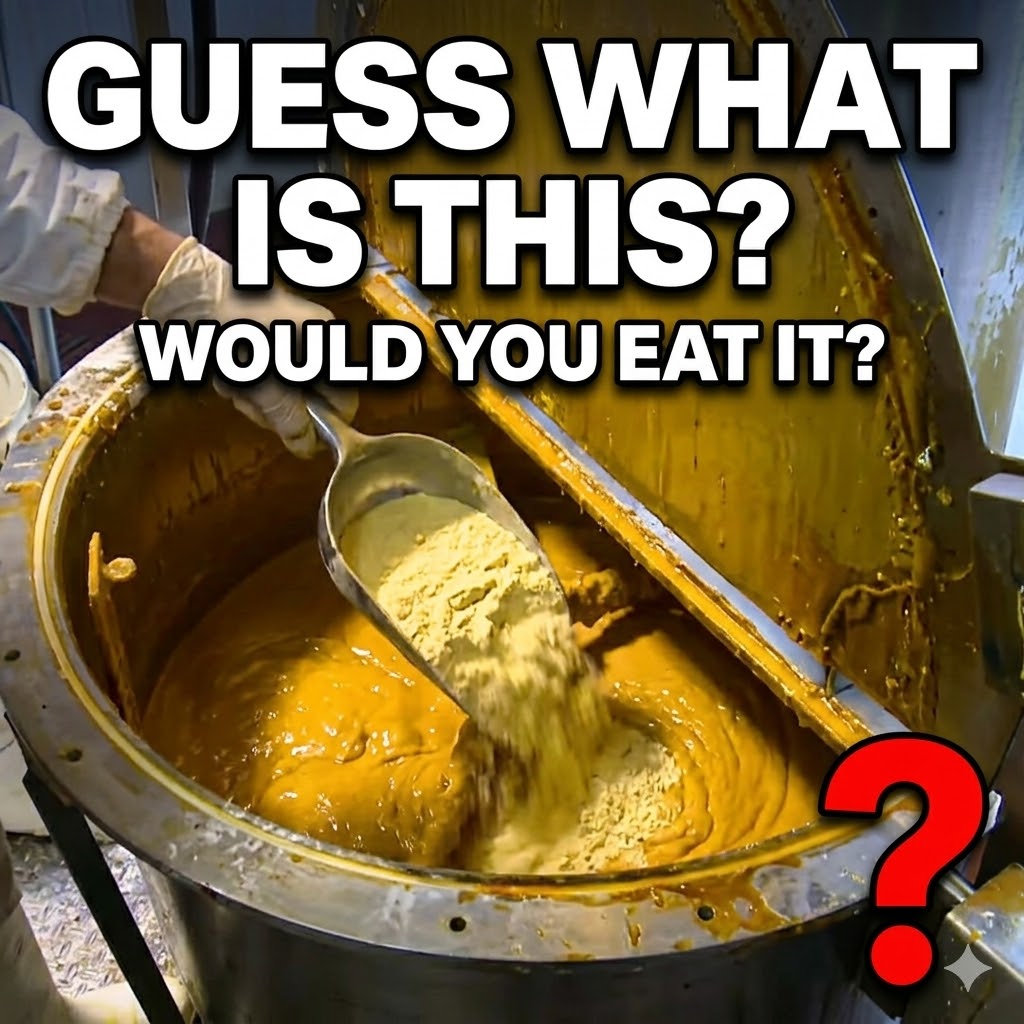
If you spend enough time scrolling through social media, you are bound to stumble upon “shock” videos exposing the behind-the-scenes realities of commercial food production. A recent viral video highlights a massive industrial mixing vat churning a thick, yellowish batter, accompanied by a bold, provocative caption: “Guess what product this is? Real food looks nothing like this. Ultra-processed. Would you still eat it?”
The grand reveal? The mysterious industrial sludge is simply the batter for fortune cookies.
The contrast between the delicate, crisp, and nostalgic cookie we break open at the end of a meal and the massive, churning vats of factory machinery can be jarring. It begs the question: are we eating something highly unnatural, or is this simply what baking looks like on a commercial scale? To answer whether you should “still eat it,” we have to break down exactly what a fortune cookie is, where it comes from, and how it is actually made.
The Unexpected Origins of the Fortune Cookie
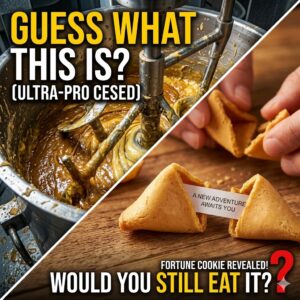
Before diving into the factory machines, it is important to understand what a fortune cookie actually is. Despite being universally handed out at the end of a meal in Chinese restaurants across North America and Europe, the fortune cookie is not a Chinese invention. In fact, if you travel to mainland China, you will be hard-pressed to find them.
A Japanese Tradition
Historical evidence traces the true origin of the fortune cookie back to Kyoto, Japan, during the 19th century. Traditional Japanese bakeries produced a slightly larger, darker cookie known as tsujiura senbei (fortune cracker). These crackers were flavored with sesame and miso rather than the vanilla and butter profiles we know today. The fortunes were wedged into the fold of the cookie rather than tucked inside the hollow center.
The American Adaptation
The modern, sweeter fortune cookie was popularized in the United States—specifically in California—during the early 20th century. Japanese immigrants in Los Angeles and San Francisco began serving them in their tea gardens. However, during World War II, when Japanese Americans were unjustly forced into internment camps, Chinese-owned restaurants in California took over the production and distribution of the cookies to meet public demand. By the time the war ended, the fortune cookie was permanently cemented in the Western world as a staple of Chinese-American cuisine.
Breaking Down the Ingredients: What is in the Vat?
When videos label food as “ultra-processed,” consumers immediately imagine a cocktail of unpronounceable chemicals and synthetic additives. However, looking inside the massive mixing vats in a fortune cookie factory reveals a surprisingly simple recipe.
While recipes vary slightly between manufacturers, the core ingredients of a standard commercial fortune cookie are:
-
Wheat Flour: The primary structural base of the cookie.
-
Sugar: To provide the signature sweetness and help the cookie crisp up and brown during baking.
-
Water: To hydrate the flour and create a liquid batter that can be easily pumped through machines.
-
Oil or Butter: Often a vegetable oil, which provides richness and prevents the batter from sticking to the industrial griddles.
-
Vanilla Extract: The dominant flavor profile of the modern Western fortune cookie.
-
Eggs: Used as a binding agent to hold the batter together.
Are there preservatives? Sometimes. To maintain a long shelf life, commercial factories may add trace amounts of preservatives or artificial colorings (like Yellow 5 or 6) to achieve a uniform golden hue. However, the core batter shown churning in those viral videos is fundamentally just a standard, liquid pancake or wafer batter. It looks industrial simply because it is being mixed in 100-gallon quantities rather than in a kitchen mixing bowl.
The Manufacturing Process: A Marvel of Engineering
The real magic—and the source of the “industrial” aesthetic—comes from the incredible machinery used to bake, fold, and stuff the cookies at lightning speed. Up until the late 1960s, fortune cookies were largely folded by hand, a labor-intensive process that required workers to handle piping-hot cookies fresh from the oven.
Today, the process is fully automated and mesmerising to watch. Here is exactly what happens on the factory floor:
-
The Mixing Phase: Ingredients are dumped by the sackful into massive industrial vats. A heavy-duty mechanical arm churns the mixture until it becomes a smooth, liquid batter.
-
The Pour: The batter is pumped through tubes and deposited in perfect, uniform circles onto a massive, moving heated griddle—essentially a giant, continuous waffle iron.
-
The Bake: The batter circles travel through a tunnel oven for just a few minutes. They are baked until they are set but still soft and pliable. If they cool down, they will shatter, so the next step must happen immediately.
-
The Fortune Insertion: As the flat, hot cookie rounds exit the oven, a machine gently vacuums or drops a pre-printed slip of paper (the fortune) directly onto the center of the dough.
-
The Fold: This is where the engineering shines. Mechanical arms push the cookie down through a slot, forcing it to fold in half (trapping the paper inside). Then, another mechanism bends the half-moon shape backwards over a blunt edge, giving it the iconic horseshoe shape.
-
The Cooling Process: The shaped cookies are immediately dropped into a cooling tunnel. As the temperature drops, the sugar sets, transforming the soft dough into the brittle, snappy cookie we know.
-
Packaging: Finally, the cookies are individually wrapped in cellophane to protect them from humidity, ensuring they remain crisp for months.
Addressing the “Ultra-Processed” Label
The video caption asks, “Would you still eat it?” implying that because the food is made in a machine, it is inherently toxic or disgusting. This taps into a growing consumer fear of ultra-processed foods (UPFs).
What Does Ultra-Processed Actually Mean?
In nutritional science, the NOVA classification system defines ultra-processed foods as formulations of ingredients, mostly of exclusive industrial use, that result from a series of industrial processes. They often contain additives to enhance flavor, texture, or shelf-life.
By this strict definition, commercial fortune cookies are ultra-processed. They are factory-made, packaged in plastic, and designed to sit on a shelf for a long time.
Is it Dangerous?
However, “processed in a factory” does not automatically mean “poison.” The shock value of the video relies entirely on the scale of the operation. Seeing a giant metal auger mix yellow sludge looks inherently less appetizing than a grandmother stirring a wooden bowl. Yet, chemically, the batter in the vat is nearly identical to what you would make at home. The factory environment simply removes the human touch to maximize efficiency and hygiene.
Fortune cookies are not a health food. They are pure refined carbohydrates and sugar. However, because they are so light—usually weighing less than 8 grams—a single cookie contains only about 30 calories and 3 grams of sugar. As an occasional treat at the end of a meal, their impact on your overall health is entirely negligible.
The Psychology of the Fortune: Why We Love Them
If the cookie itself is just a simple, mass-produced sugar wafer, why do we care so much about them? The answer lies in the slip of paper inside.
The fortune cookie is a masterpiece of experiential dining. It is one of the only foods we eat not primarily for the taste, but for the interactive experience. Breaking the cookie creates a satisfying auditory snap, and reading the fortune provides a momentary spark of anticipation.
Over the decades, the fortunes themselves have evolved. Originally, they featured literal fortunes or profound philosophical quotes. Today, massive printing presses generate thousands of different slips, ranging from vague horoscopes (“You will soon encounter a great opportunity”) to lucky lottery numbers, to vocabulary lessons in Mandarin. The novelty of the fortune supersedes the industrial nature of the cookie.
Conclusion: Should You Still Eat It?
Viral videos are designed to generate clicks through shock and disgust. When a creator zooms in on a massive vat of yellow batter and asks, “Would you still eat this?”, they are hoping your answer is no.
But the reality is far less sinister. Fortune cookies are a fascinating blend of international history and modern engineering. They are born from Japanese tradition, popularized by Chinese-American immigrants, and sustained by incredible culinary machinery. The ingredients are simple—flour, sugar, water, and vanilla—mixed on a massive scale to bring a tiny moment of joy to the end of your dinner.
So, the next time your takeout order arrives with that familiar cellophane-wrapped treat, you don’t need to fear the factory it came from. Break it open, read your fortune, and enjoy the crunch.